.png?alt=media&token=155810c5-21da-41d1-bf73-5df542c25145)
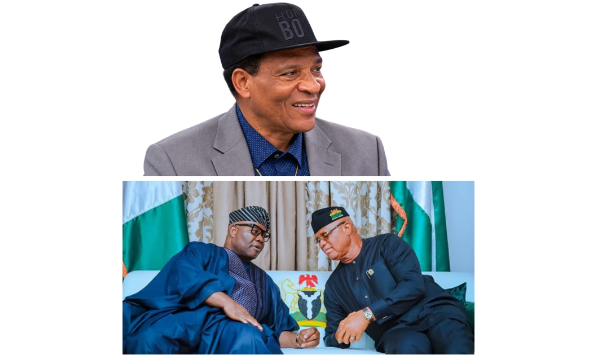
By Dr. Mike Uyi, President, Global Peace Movement International
There is a tendency in Nigerian politics to measure development by who commissioned a project. That is the wrong measurement.
The more important question is: Who laid the foundation, who sustained it, and who had the courage to take it further?
By that standard, the story of modern Akwa Ibom deserves a different reading.
If President Bola Ahmed Tinubu is regarded as the father of modern Lagos, then Senate President, Godswill Akpabio has earned his place as the father of modern Akwa Ibom.
Akpabio did not invent every development idea in the state, but his eight years in office fundamentally changed the scale, speed and ambition of development in Akwa Ibom. His administration pushed roads, bridges, flyovers, healthcare, education, tourism, aviation and other infrastructure to a level that permanently altered the state's physical and economic landscape.
The airport remains one of the clearest examples. What began as a mere land approval by Victor Attah received substantial development under Akpabio and ultimately became one of the pillars of the state's aviation ambitions.
Years later, Governor Umo Eno is showing what happens when a successor understands that development should be inherited, improved and expanded - not demolished for political reasons.
The fifth new Airbus A220-300 acquired for Ibom Air by the Eno administration, received in Uyo at the beginning of the state's 39th anniversary month, is therefore much bigger than an aircraft.
It is a picture of continuity in motion.
The aircraft arrived with Captain Ruth Adebanwo at the controls. On the ground was Governor Umo Eno. Also present was Senator Godswill Akpabio, the former governor whose administration helped create much of the infrastructure upon which today's aviation ambitions rest.
There could hardly be a more powerful picture of succession and continuity. Akpabio laid the foundation. Eno is building on it.
And that, in my view, is the real story of Akwa Ibom at 39.
Governor Eno has taken the state's aviation ambition beyond simply owning an airline. His administration is expanding the fleet, investing in aviation manpower and pursuing the development of an aviation ecosystem capable of creating jobs and positioning Akwa Ibom as a regional aviation hub.
This is what mature governance should look like. A governor should not spend four or eight years trying to prove that everything his predecessor did was wrong.
A governor should ask: What did I inherit? What works? What can I improve? What can I add? Akwa Ibom appears to be answering those questions differently.
The 39th anniversary programme, with 39 projects scheduled for commissioning across the state, demonstrates an administration seeking to translate the ARISE agenda into tangible development across sectors.
And there is something else worth celebrating: the politics of continuity.
At the Airbus reception, Akpabio praised Eno for completing projects initiated by earlier administrations and described continuity as important to development. That statement should resonate beyond Akwa Ibom.
Nigeria needs more of this. We cannot continue to build airports, roads, hospitals, schools and industries as monuments to individual politicians. They belong to the people. Once public money has been committed and a project has strategic value, its usefulness should survive the administration that initiated it.
Akpabio's contribution to Akwa Ibom was to establish a developmental template of ambition, infrastructure and confidence. Eno's contribution is increasingly becoming one of consolidation and expansion. The former governor demonstrated what Akwa Ibom could become. The incumbent is demonstrating how that vision can be sustained and enlarged. That is why the September celebration themed "Gratitude" is appropriate.
At 39, Akwa Ibom should be grateful for the leaders who laid its foundations, grateful for those who have preserved its gains, and demanding enough to expect every succeeding administration to build higher.
The real legacy of leadership is not the number of projects named after a politician. It is whether the next generation inherits a stronger state than the previous generation received.
Akpabio helped create that foundation. Umo Eno is building on it.
And if this culture of continuity survives political transitions, Akwa Ibom may ultimately prove that the most enduring form of political legacy is not who started the project, but who had the wisdom to finish it and make it work for the people.