.png?alt=media&token=155810c5-21da-41d1-bf73-5df542c25145)
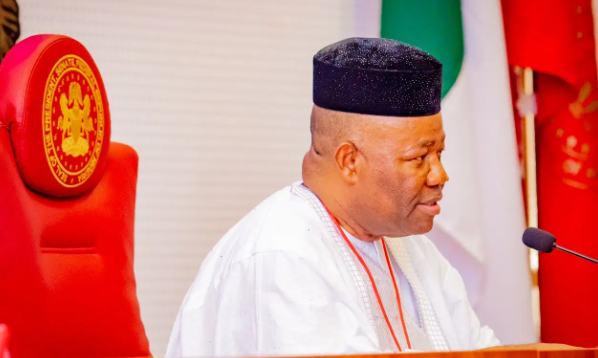
Nigeria has moved closer than ever to establishing a state police force after the Senate passed the controversial Constitution Alteration Bill seeking to decentralize policing, shifting the battle for the landmark reform to the 36 state Houses of Assembly where at least 24 legislatures must endorse the proposal before it can become law.
The passage of the bill by the Senate marks a major breakthrough in a debate that has dominated Nigeria’s security discourse for decades and comes amid worsening insecurity across several parts of the country, including terrorism, banditry, kidnapping, communal violence and organized criminal activities.
The legislation, which seeks to establish state-controlled police services alongside the existing Nigeria Police Force, was approved after senators secured the constitutionally required two-thirds majority through a manual voting process adopted following technical glitches that affected the chamber’s electronic voting devices.
With both chambers of the National Assembly now backing the proposal, attention has shifted to state assemblies, whose approval will determine whether Nigeria finally abandons its long-standing exclusive federal policing structure.
The proposed amendment is widely regarded as one of the most consequential constitutional reforms undertaken since the return to democratic rule in 1999. At the center of the reform is a provision empowering governors to appoint Commissioners of Police for their respective states, subject to confirmation by state Houses of Assembly.
Under Clause 17 of the proposed constitutional amendment, while the Federal Police Service will continue to be headed by the Inspector-General of Police, each State Police Service shall be headed by a Commissioner of Police appointed by the governor and confirmed by the legislature of the state.
The development effectively creates a dual policing structure in which state police formations would operate concurrently with federal police authorities.
The Senate approved the bill after considering the report of the Senate Committee on the Review of the Constitution presented by Deputy Senate President and committee chairman, Barau Jibrin.
The bill’s provisions were first considered at the Committee of the Whole before lawmakers adopted them and proceeded to a final vote.
Leading debate on the legislation, Senate Leader, Senator Opeyemi Bamidele, described the proposal as a carefully designed framework aimed at balancing local policing autonomy with national cohesion. He further stated that the bill is intended to retain the Nigeria Police Force for federal policing duties while providing for the establishment of state police services in states that choose to adopt them.
According to him, state police would be responsible for enforcing state laws, maintaining public safety and public order, preventing and detecting crimes within their jurisdictions, protecting lives and property and carrying out other local policing duties.
On the responsibilities of the federal police, Bamidele noted that the federal police would be in charge of protecting federal institutions, counter-terrorism, organized crime, cybercrime, border security, arms trafficking, interstate criminal activities and other national security matters.
The Senate Leader also clarified the conditions under which federal police authorities could intervene in security situations within states and explained that intervention would only occur where there is outright breakdown of public order at a specific subnational entity; when state police are incapable of functioning; when there is serious violation of fundamental rights; when there is an established record of electoral intimidation and when national security is under threat.
According to him, such intervention would require written authorization from the President and Commander-in-Chief and would remain subject to Senate oversight and judicial review. Indeed, fears that state police could become instruments of intimidation against opposition figures, critics and civil society groups have historically been one of the strongest arguments against decentralized policing.
The delineation of powers was one of several safeguards introduced by lawmakers to address long-standing concerns that governors could abuse state police formations for political purposes. To address such concerns, senators inserted explicit anti-abuse provisions into the constitutional amendment.
One of the key safeguards adopted by the Senate provides that a state Commissioner of Police shall not arrest, detain, investigate or deploy force against any person, political party or group merely for criticizing the government except in accordance with the law. The provision is expected to serve as a constitutional shield against politically motivated arrests and abuse of power.
In addition, lawmakers proposed that the National Assembly should retain powers to prescribe minimum national standards relating to recruitment, training, vetting, promotion, discipline, use of force, firearms, complaints procedures, accountability mechanisms, data management and professional conduct for state police services. Bamidele said the proposed framework generally seeks to balance local policing autonomy with national cohesion, accountability with operational effectiveness and federal oversight with state responsibility.
Successive administrations, constitutional conferences, security experts and governors have repeatedly canvassed the idea, arguing that Nigeria’s highly centralized policing arrangement has become increasingly inadequate for a federation of more than 200 million people. Supporters argue that officers recruited locally would possess a better understanding of their environment, language, culture and security dynamics, thereby improving intelligence gathering and crime prevention.
They also contend that state governments, which already spend billions of naira supporting federal security agencies, should have greater control over policing within their territories.
The Senate was initially expected to deploy electronic voting for the constitutional amendment exercise. However, technical glitches affecting some voting devices forced lawmakers to abandon the plan and resort to manual voting. Following the adoption of the motion, senators were called individually to publicly declare their positions during the clause-by-clause consideration of the constitutional amendment bills.
To facilitate the process, the Senate suspended the relevant provisions of its Standing Rules through a voice vote. The exercise attracted top government officials and governors who observed proceedings from the gallery. Among those present were Kaduna State Governor, Senator Uba Sani; Ogun State Governor, Dapo Abiodun; Ondo State Governor, Lucky Aiyedatiwa; and the Chief of Staff to the President, Femi Gbajabiamila. heir presence underscored the enormous political and security implications of the proposed reform.
Outside the National Assembly, support for the bill also came from retired Assistant Inspector-General of Police, Aare Tunji Alapinni, who described state police as an opportunity to strengthen grassroots security and revive community policing.
Speaking during an interview on a current affairs program, Alapinni urged Nigerians to embrace the initiative. The retired police chief argued that one of the greatest benefits of state policing would be the revival of community intelligence networks. “Twenty years ago, if a stranger comes into town, people walking around would notice that this man is a stranger and the community will watch him. That’s part of the things we have lost. Those are the things we want to gain with community policing,” he said.
Similarly, the Western Nigeria Security Network, popularly known as Amotekun, has disclosed that the South West is well positioned for a seamless transition to state policing. While declaring full operational readiness for the much-anticipated security reform, the chairman of Amotekun commanders in the region, Adetunji Adeleye, stressed that the decentralisation of Nigeria’s security architecture remains the most viable solution to the country’s insecurity challenges.
Established in 2020 by the six South-West governors, Amotekun has operated as a regional security initiative designed to complement the efforts of the Nigeria Police Force in tackling crimes such as kidnapping, banditry, armed robbery, among others. Adetunji, who is the commander of the corps in Ondo State, cited the success of the Amotekun initiative as evidence that community-based security frameworks are more effective in identifying and apprehending criminals at community and state levels.