.png?alt=media&token=155810c5-21da-41d1-bf73-5df542c25145)
By Israel Adebiyi
Stakeholders in Edo State have intensified calls for decisive and coordinated action against gender-based violence, describing the menace as a growing threat to the safety, dignity and development of women and girls across communities.
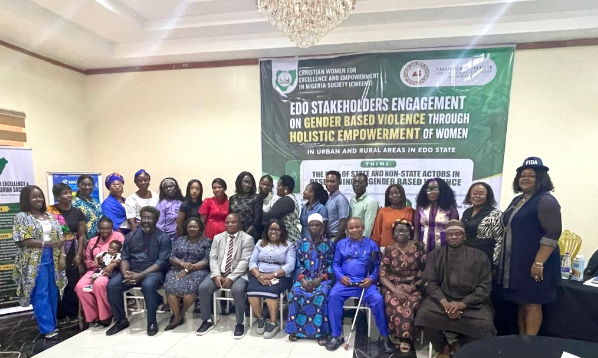
The renewed commitment was made during a stakeholders’ engagement organised by the Christian Women for Excellence and Empowerment in Nigeria Society, CWEENS, in Benin City, with the theme, “The Role of State and Non-State Actors in Responding to Gender-Based Violence.”
Participants at the gathering, which drew representatives from government ministries, civil society groups, religious organisations, academia, development advocates, traditional institutions and community leaders, stressed the urgent need for stronger institutional support, improved reporting mechanisms and sustained public enlightenment to curb the rising cases of abuse and discrimination.
Speaking at the event, the Coordinator of CWEENS, Professor Yinka Omorogbe, whose messages were reinforced by the Assistant Coordinator, Dr Victoria Adeleye said the programme was convened to promote practical solutions aimed at protecting women and girls from violence, harmful cultural practices and all forms of discrimination.
She noted that despite increasing awareness campaigns, many victims still suffer in silence due to fear, stigma, economic dependence and lack of confidence in existing support systems.
She maintained that gender-based violence goes beyond physical assault, explaining that emotional abuse, sexual violence, economic deprivation and psychological intimidation continue to undermine the wellbeing and productivity of women in society.
According to her, tackling the problem requires collective action from government institutions, traditional rulers, faith-based groups, civil society organisations and families.
The Assistant Coordinator of CWEENS, also underscored the importance of sustained advocacy and community engagement, stating that women and girls must be empowered to speak out against abuse without fear of victimisation.
Delivering the keynote address, Professor Margaret Abikwi described gender-based violence as a serious social challenge with far-reaching consequences on families and national development.
Professor Abikwi said non-state actors such as civil society organisations, women advocacy groups, religious bodies, community associations and the media have a crucial role to play in combating gender-based violence through advocacy, awareness creation and support for survivors.
She noted that many victims often turn first to community leaders, faith-based organisations and non-governmental groups before approaching government agencies, making the role of non-state actors indispensable in the fight against abuse.
According to her, collaboration between government institutions and non-state actors would help strengthen reporting systems, improve access to counselling and rehabilitation services and ensure quicker interventions for victims.
Professor Abikwi advocated the establishment of more counselling centres and support structures for survivors, while urging non-governmental organisations and community groups to intensify sensitisation campaigns, especially in rural communities where harmful cultural practices still persist.
She further stressed the need for schools, religious institutions and media organisations to champion value reorientation and promote respect for the rights and dignity of women and girls.
In his lecture, the Chief Responsibility Officer of the Josémaria Escrivá Foundation, Dr. Jude Obasanmi, emphasised the importance of stronger collaboration between state and non-state actors in addressing gender-based violence.
Dr. Obasanmi stated that while government has the responsibility of formulating policies and enforcing laws, non-state actors remain critical in prevention, advocacy, rehabilitation and community mobilisation.
He explained that civil society groups, humanitarian organisations, traditional institutions and the media possess the grassroots reach required to identify vulnerable persons, educate communities and encourage victims to speak out.
According to him, effective partnership between government agencies and non-state actors would improve public trust, strengthen data gathering on abuse cases and ensure sustained follow-up on reported incidents.
Dr. Obasanmi also called for increased funding for gender protection programmes, capacity building for law enforcement personnel and greater involvement of religious and community leaders in promoting peaceful family relationships and social values.
He called for improved legal protection for survivors, increased access to justice and stronger implementation of existing laws designed to safeguard vulnerable persons.
Participants at the engagement highlighted poverty, unemployment, substance abuse and weak family structures among factors contributing to the persistence of gender-based violence in society.
They called for stronger enforcement of laws protecting women and children, as well as the domestication and implementation of relevant gender protection policies at all levels.
The highlight of the programme was the signing of the Edo Stakeholders Commitment Charter on Combating Gender-Based Violence by various stakeholders, who pledged to work collectively towards preventing abuse, protecting survivors and promoting safer communities across the state.
The stakeholders expressed optimism that sustained collaboration, public education and institutional reforms would help reduce the prevalence of gender-based violence and encourage a culture of respect, equality and justice in society.