.png?alt=media&token=155810c5-21da-41d1-bf73-5df542c25145)
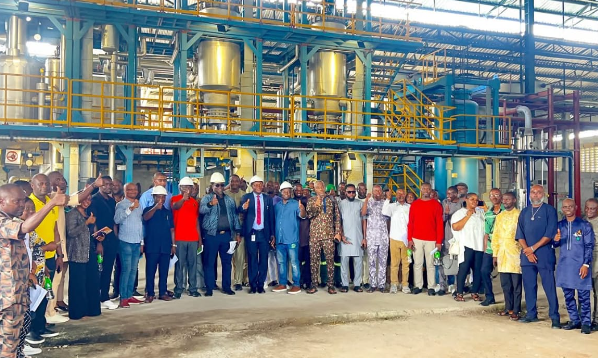
The Nigerian Content Development and Monitoring Board (NCDMB) has commended Bunorr Integrated Energy Limited for its renewed operational excellence and contribution to Nigeria’s circular industrial economy through the recycling of used engine oil into base oil.
Speaking at the Bunorr facility in Omagwa Rivers State during a two-day media tour organised by the NCDMB, the General Manager, Corporate Communications, Obinna Ezeobi represented by the Government Relations Supervisor, Teddy Bai said the company reflects the standard of excellence expected from Nigerian-owned energy firms, stressing, “We encourage local capacity, and we are confident in the responsibilities that local content represents; you are producing quality, and you are managing quality.”
Ezeobi highlighted the Board’s position on environmental responsibility and clean energy practices, noting that Bunorr’s regulated operations contrast sharply with unsafe disposal methods. “At NCDMB we encourage local content capacity building and local competition. We don’t play down on competence. we also pursue excellence,” he said, adding, “Pollution is not what our brothers do alone in the creek; those of us who have four to five cars and service our cars every month and waste that used oil, we are also polluting our environment. Also, that used oil can generate money for us.”
Bunorr’s Managing Director, Okeke Modestus who conducted journalists and NCDMB staff around the plant, described the Board as a critical partner in the firm’s progress.
He said, “The NCDMB backing gave us credibility before vendors, financial institutions, and other stakeholders,” adding that the support helped attract technical partners and negotiate for materials and other inputs.
Okeke revealed that the NCDMB provided Bunorr with a $3.6 million equity fund, which enabled the company to commence operations and contribute to the national supply chain.
He added, “NCDMB’s periodic engagements helped us improve our operational standards, enhance safety culture, and adopt best practices in the recycling and lubricant recovery industry.” He further stated, “Our operations directly support Nigeria’s commitment to energy circularity, environmental sustainability, local content development, and import substitution.”
The Managing Director appealed to the State government to connect the Omagwa axis of Rivers State to the national grid to reduce production costs, noting that access to public power would boost the company’s capacity to expand its indigenous operations.
By Brenda Izu